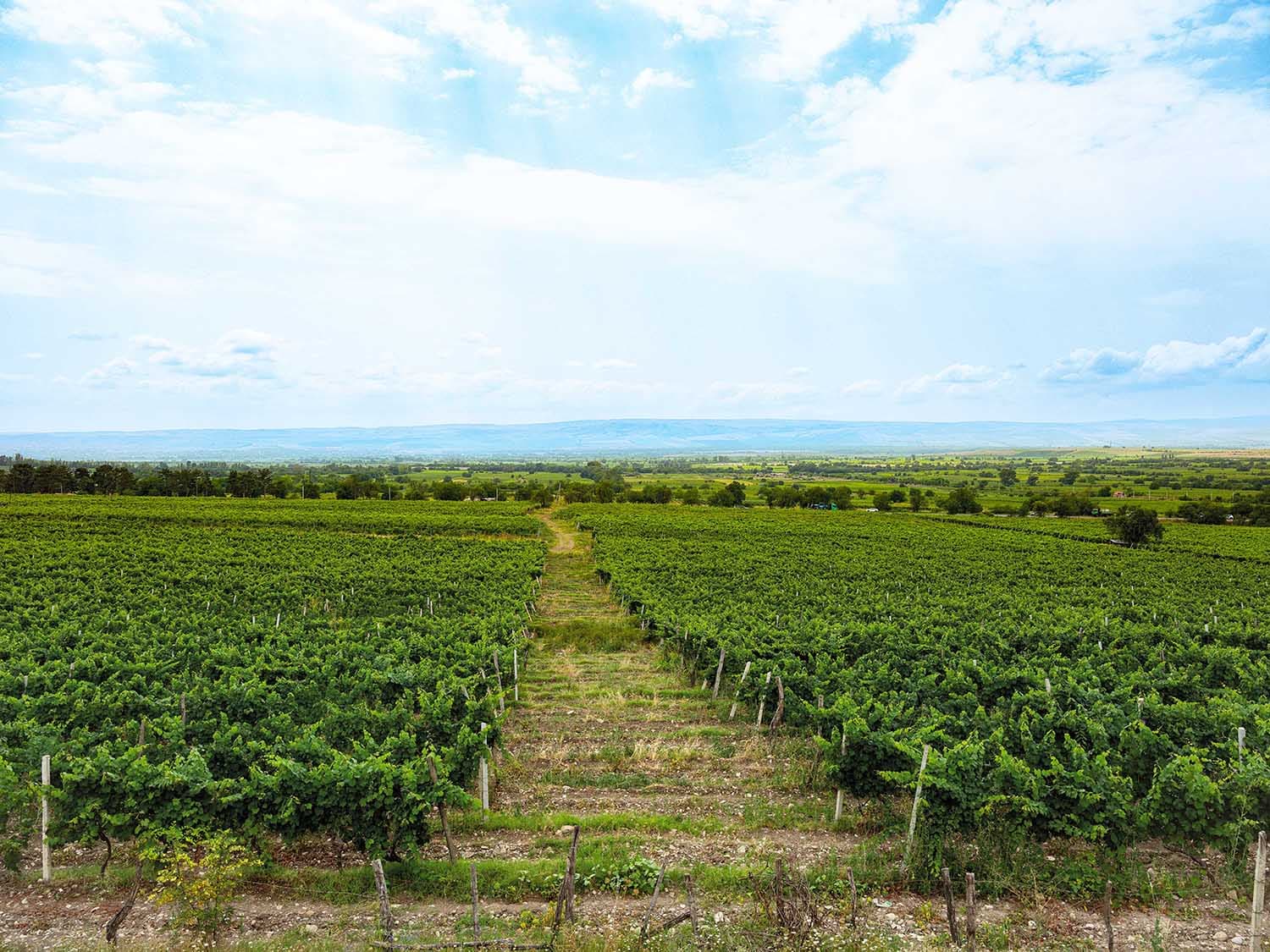
On the road from Tbilisi to Kakabeti, upon entering the village, a striking landscape opens up to your left: a wave of vineyards stretching like the sea across forty hectares, where the wines of the 6000 B.C. winery are born.
It was only recently that the 6000 B.C. winery entered the local market with a range of six wines. Since opening in 2024, the winery quickly made an impression with its distinctive visual identity and contemporary aesthetic, qualities that resonate with today’s wine lovers.
They belong to a category where tradition and a modern outlook exist in complete harmony. Coming alive in the glass with confidence, they form such refined pairings with food that it soon becomes clear that behind the wine lies a carefully considered philosophy.

When you pick up the bottle, you realise that this is more than just a drink. It is a history spanning centuries, a door into the past unlocked through wine. The circular opening on the label, which you are meant to look into, brings to life Georgia’s eight-thousand-year tradition of uninterrupted winemaking, dating back 6,000 years B.C. and spanning the 2,000 years since. This is why Avto Cheishvili and Salome Chikovani chose 6000 B.C. as the name of their winery.

Avto’s approach to his work is remarkably sincere. Every time we have met to taste the wines or discuss their evaluations, he has left me with the same impression. His father was a doctor and had no professional connection to winemaking, but in Georgia, winemaking is deeply embedded in our genes and blood. Avto carries a deep sense of responsibility. What began as an undertaking rooted in respect for his father’s memory has already taken shape in the form of the intriguing wines of 6000 B.C. He has a healthy and unwavering ambition: to see Georgia, the homeland of wine, take its rightful and deserved place on the world wine map. His winery serves precisely this purpose, producing modern wines of uncompromising quality.
The Vineyards of Kakabeti: The Waves of a Green Sea on a Sunlit Slope
Despite the scorching summer days, I had made up my mind to visit the vineyards where these wines are born. On arrival, we were welcomed by Avto and Salome, together with Temur Meurmishvili, an agronomist with 45 years of experience. We climbed to the highest point of the naturally sloping hillside, from where we looked out over forty hectares of vineyards stretching across the hillside in gentle waves. Of the total area, 32 hectares are planted with Mtsvane; the remainder is home to Saperavi, Rkatsiteli, and several rare endemic Georgian varieties, including Budeshuri Saperavi, Tamaris Vazi, Chitistvala, and Kakhuri Mtsvivani, which I will elaborate on below.

These vineyards are located in Kakabeti, Sagarejo Municipality (Outer Kakheti), one of the region’s distinctive wine-growing areas, where the natural conditions provide a suitable environment for producing high-quality wine grapes. Along with several neighbouring villages, Kakabeti falls within the Manavi Specific Viticultural Zone. The local climate and stony, unirrigated soils are well suited to varieties such as Mtsvane and Saperavi.
Avto and Salome’s vineyards are 20 to 22 years old. The unirrigated land encourages the vines to develop deep root systems that reach down into the lower layers of the soil, helping them yield high-quality grapes. With quality as the absolute priority, yields are deliberately limited to 6 to 7 tonnes per hectare, a process overseen by Temur, an experienced viticulturist.

Despite producing more than 20,000 bottles of wine a year, 6000 B.C. is not focused solely on commercial success. These are contemporary Georgian wines that represent the country with distinction on the international stage. Behind them is a team of professionals whose combined expertise brings these wines to life.
As mentioned earlier, the vineyards here are particularly well-suited to growing Mtsvane and Saperavi. We discuss the wines produced from these varieties by 6000 B.C. with Professor of Winemaking David Chichua and Master of Oenology Giorgi Samanishvili.
6000 B.C. Manavi Mtsvane | 2024 vintage | Kakabeti, Kakheti
David Chichua
How is great wine born? The birth of great wine requires a meeting of terroir and human endeavour. Great wine cannot emerge without the two coming together. People, in turn, must work with enthusiasm, passion, knowledge and a sound understanding of tradition.
Georgia is a country with an 8,000-year history of winemaking. This is both an honour and, in some ways, a burden, because this centuries-old heritage can become a constraint that many winemakers find difficult to move beyond. It is good to see that at 6000 B.C., respect for tradition had not become such a constraint.


Here, the terroir of Manavi-Kakabeti, the unirrigated vineyards, carefully controlled yields and healthy grapes, together with a winemaker who has not allowed respect for tradition to become a burden, but has instead boldly integrated modernity into our 8,000-year history, come together to create a wine that, on the one hand, reflects the character of the terroir and, on the other, is the product of the winemaking approach chosen by Avto Cheishvili.
6000 B.C. Saperavi | 2023 vintage | Kakabeti, Kakheti
Giorgi Samanishvili
Around 40 to 50 years ago, this area was not considered particularly well-suited to Saperavi. Over the past few decades, global warming and climate change have shifted Saperavi’s cultivation zone to slightly higher elevations. Today, in Outer Kakheti, whether in Sagarejo, Kakabeti, or Manavi, we find Saperavi that is delicate and aromatic, yet also powerful.


This wine beautifully expresses the place, the variety, and the character. The Kakabeti microzone is one of the best places for growing Saperavi, and the wine clearly reflects that. It is a 2023 vintage and still retains its purple hue and reflections, showing that the wine has developed without losing the deep colour and tonal character of a young wine. The aromas clearly display berry notes of blackberry and mulberry, although they lean towards sweeter notes of dried fruit and jam here. On the palate, the tannins are evident. Yes, this wine is still very much driven by tannin, but the tannins are beautifully balanced with the fruit aromas. There is also a touch of oak, but it is very light and pleasant. As you taste the wine, nothing feels excessive. The aromas complement the good acidity and alcohol in harmony, resulting in a long finish. This wine is an excellent example of the potential Kakabeti, Manavi, and Outer Kakheti have for Saperavi.

Rare Endemic Varieties as an Investment in the Future
We spent several hours in the Kakabeti vineyards. We were still making our way along the rows of Mtsvane when Avto and Temur mentioned Tamaris Vazi, followed by Chitistvala and Shavi Rkatsiteli. By then, we had reached the two-hectare area where these rare varieties are planted. Here, you will find Shavi Rkatsiteli, Vardisperi Rkatsiteli, Kakhuri Mtsvivani, Chitistvala, and Tamaris Vazi, a historic endemic variety from Samtskhe-Javakheti that is now being revived in the soils of Outer Kakheti. There is also Budeshurisebri Saperavi (out of the two types of this variety, round-berried and long-berried; the long-berried form is planted here).

When I asked Avto why they had decided to plant these rare varieties, he gave me his usual candid answer: ‘If each of us can do even a little to reclaim and revive these endangered varieties, the potential of Georgian winemaking will be unlocked on an entirely new scale. That is my goal.’
Six Stories in a Bottle
The 6000 B.C. portfolio brings together wines made using classic, qvevri, and barrel methods. These 6000 B.C. wines are currently available at around 100 venues in Tbilisi, including specialist wine shops and high-end dining establishments. Outside Georgia, they are available in the United States, the United Kingdom, Germany, Estonia, and Latvia. Expanding their export markets is among Avto and Salome’s immediate plans.


Manavi | Classic Dry White Wine
Made using the classic (European) method, this dry white wine brings out the distinctive terroir of the Manavi microzone and the natural elegance of the Mtsvane grape. It has a bright straw colour and delicate aromas of white cherry, citrus zest, and meadow flowers. The palate is harmonious and lively, with a long, refreshing finish. It pairs beautifully with seafood, fish, and fresh cheese.
Mtsvane | Semi-Sweet White Wine
A semi-sweet white wine made using the classic method, in which the natural aromatic character of the Mtsvane grape is perfectly balanced by its sweetness. It displays tropical aromas of pineapple, mango, and ripe peach. The palate is soft and velvety. An ideal pairing for fruit desserts and Asian cuisine.
Kisi Maghraani | Amber Dry Wine
An amber dry wine made using the traditional qvevri method. Alongside notes of white fruit, dried fruit, and honey, it is distinguished by powerful, structured tannins developed through extended maceration in qvevri, with an impressive finish.
Mtsvane | Qvevri | Amber Dry Wine
Made using the traditional Georgian qvevri method, this amber dry wine has an intense colour and rich notes of ripe fruit, quince, dried fruit, honey, and a delicate hint of caramel. Full-bodied, with soft tannins and a layered structure, it pairs beautifully with traditional Georgian dishes and aged cheese.
Mukuzani | Dry Red Wine
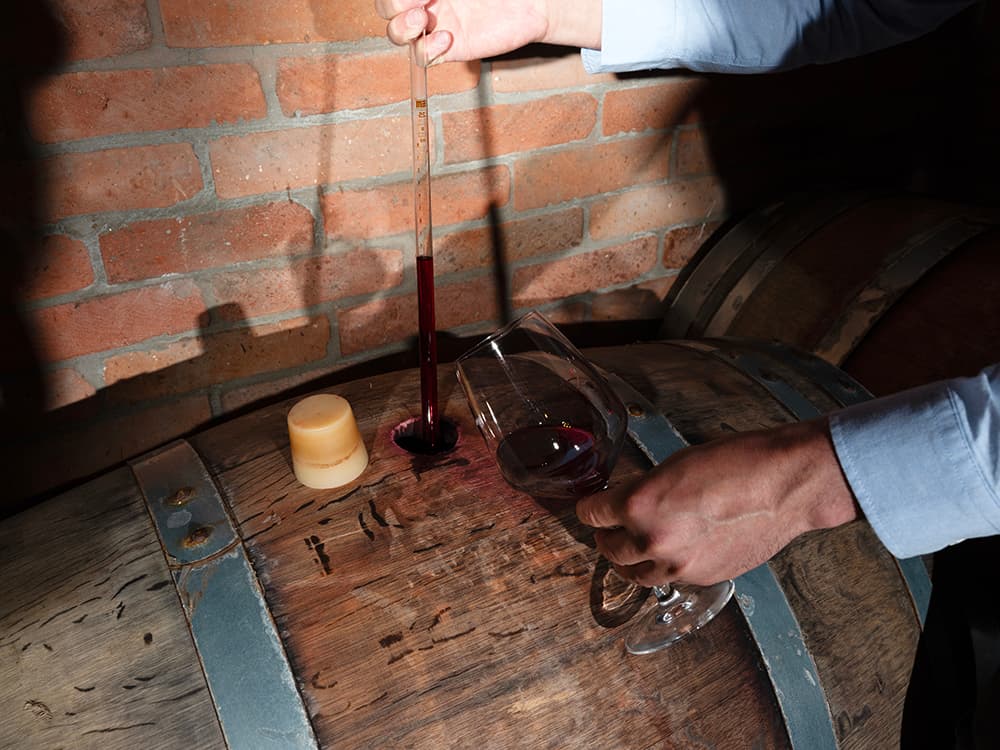
A premium dry red wine aged in oak barrels, with elegant notes of ripe blackberry, cherry jam, black plum, and vanilla, creating a rounded, full-bodied, and refined structure. It pairs particularly well with steak and game meats.
Saperavi | Dry Red Wine
A dry red wine made using the classic method, expressing the richness and intense character of Saperavi. Deep ruby-cherry in colour, it offers delicate aromas of blackberry, black cherry and mint. Full-bodied, juicy and well-balanced, it pairs beautifully with red meat, particularly mtsvadi (traditional Georgian skewered meat).