
Giorgi Samanishvili | MSc in Oenology |
In this article we will explore a particularly interesting and complex subject: Georgian spirits. Today, spirits are widespread across the world and far more diverse than just those made from grapes. The geographic range of the vine remains limited, whereas spirits can be produced in any region from whatever raw materials are available locally. It is also worth noting that spirits have a longer history in Georgia than in Western Europe. The culture and technique of distillation reached Europe from the East in the late Middle Ages, whereas in Georgia this technology appeared and became established much earlier, in the early Middle Ages.
Spirit drinks are produced from ethyl alcohol of agricultural origin. In turn, this alcohol is classified into two categories according to both Georgian legislation and European Union regulations: neutral (rectified) alcohol and distillates. Neutral alcohol must have an alcohol strength of at least 96% vol, be highly purified and, most importantly, in my view, have a completely neutral smell and taste. It can be produced from pomace, wine, wheat, or any other raw material. The definition of a distillates specifies that it must contain a legally defined minimum amount of volatile compounds and should retain the aroma and flavour of the original raw material.
One of the best-known spirits made from neutral alcohol is vodka, known by that name in every language except Georgian, where it has been translated to araki.
As for distillates, they are used to make traditional spirits with distinctive aromas and flavours, which go by different names in different languages: Eau de vie in French, Spirit in English, Brandy outside the European Union, Brand in German, Pálenka in number of Eastern European countries, and many others. Spirits made from distillates include: various fruit, grape, and pomace vodkas, honey vodka, and brandy, i.e., wine brandy.
In Georgia, among these spirits, I believe the most distinctive, recognised, and refined is Georgian brandy. The oldest and most traditional, however, is our celebrated pomace spirit -i.e., chacha.

Giorgi Tevzadze | ‘Riravo - Wild Fruit Chacha’. ‘Crash 525’ |: In Georgia, only a small amount of chacha is produced commercially. As a national spirit, it needs far more attention and wider recognition. Chacha is not valued here in the way grappa is in Italy, and there is a great deal of work to be done in this direction.
Giorgi Samanishvili: Chacha, like our fruit spirits, has genuinely strong potential. Every region of Georgia has always distilled spirits and continues to do so today. In areas where grapes are more widely grown, people distill grape spirits, while in regions rich in fruit, they make fruit spirits instead.
Giorgi Tevzadze: In the last century, Giorgi Bolkvadze, David Sarajishvili, and the Zubalashvili brothers produced remarkable fruit liqueurs, spirits, and brandies. At that time, however, this type of drink did not have a clearly defined category. Despite this, their beverages received top awards and medals at exhibitions in countries around the world. The production of high-alcohol spirits is an important part of our cultural heritage.
David Abzianidze | Chief Technologist, ‘Sarajishvili’ Company |: Chacha is protected as a geographical indication, which means that no one outside Georgia has the right to produce it.
Giorgi Samanishvili: I agree. In general, chacha falls into the categories of pomace brandy, pomace spirit, or grape marc spirit. We have a protected designation, chacha, which can only be produced in Georgia.
In the European Union, the production of pomace spirits is subject to limits on the amount of wine and lees they may contain. Pomace spirits must be made from pressed, dry pomace, and the wine-and-lees content cannot exceed 25%, which, in my view, has a positive effect on their character and quality. Countries such as Italy, Bulgaria, and others also distinguish two categories: pomace spirit and grape spirit. In the case of grape spirit, the whole pomace can be distilled, resulting in a drink with a relatively delicate taste and subtle aromas, making it easier to drink.
Levan Ujmajuridze |Director of the LEPL Scientific-Research Center of Agriculture, Professor, Academician |: To raise the profile of chacha, it is desirable to take grape varietal diversity into account. Chacha made from individual grape varieties carries far more interesting flavours. This is precisely what drives the spirit’s recognition, selection, and diversification. Variety is what makes the drink truly engaging.
Varietal chacha is just as interesting as varietal wines. Foreign visitors, including the French, often ask why we do not use blends more frequently. The real charm of Georgian winemaking lies in the fact that production is based not on four or five varieties, but on several hundred, so blending is needed only in certain cases. The same approach should apply to chacha, with differentiated grape varieties distilled separately.
Giorgi Tevzadze: As a rule, chacha must be 100 % chacha, and no other flavours may be added; just as it would be unacceptable to distill wine and call it chacha.
Regarding aromatic varieties, we have distilled Muscat grapes grown at the Jighaura base of the Agricultural Research Centre, with very good results. I think it would also be interesting to try Gewürztraminer from the same vineyard. Plans for the future include distilling Kisi, Khikhvi, Chkhaveri, Tavkveri, and Krakhuna. There are many exciting experiments and outcomes ahead. It’s worth mentioning that, while working in Racha at the Naberauli Wine Company, we distilled Aleksandrouli, Mujuretuli, Mtsvane Kakhuri, and Tsolikouri together, as we had accumulated enough pomace. The resulting spirit had very pleasant aromas.
Giorgi Samanishvili: Chacha distilled from aromatic (Muscat) varieties is tasted separately at tastings. Within this category, Gewürztraminer stands out in particular. In my view, chacha from this variety is especially interesting, because it has less pronounced Muscat aromas, and after concentration it becomes a very pleasant spirit. A separate category is the so-called neutral varieties, which can more or less be brought into a single style. Riravo’s chacha is precisely such an example, showing the spirit at its best.
Giorgi Tevzadze: From our experience, chacha with oak aromas is less interesting for export markets. In European countries, buyers are particularly drawn to chacha with a clear, light colour, rather than one aged in oak, which I think is worth keeping in mind.
Levan Ujmajuridze: Riravo’s range includes a quince distillate, which has interesting flavours and aromas. Are these naturally derived from the distillation process?
Giorgi Tevzadze: Indeed. In this chacha, 20% apple has been added. We do the same with feijoa pomace. Feijoa and quince have strong aromas, and we balance them out by adding apples. Chacha distilled from the sweetest and most aromatic fruits, such as figs, is particularly interesting.
Levan Ujmajuridze: Incidentally, Georgia is not only the homeland of grapes, wine, and wheat, but also one of the places of origin of the fig. Research conducted together with our Chinese colleagues confirmed the local origin of this fruit.
As noted above, in chacha, the grape variety is of particular importance, and in fruit chacha, both the fruit species and its variety are crucial. This is something that must be carefully considered.
Giorgi Tevzadze: Distilling spirits from fruit has a fascinating history in Georgia. If we look at historical records, for example, David Sarajishvili in Akhaltsikhe distilled spirits not only from mulberries, but also from chanchuri (a local plum) and apricots. Unfortunately, the tradition of distilling apricot spirits is no longer widely practiced today.
Levan Ujmajuridze: Life in Meskheti would be unimaginable without mulberry spirit. In this region, not only is mulberry spirit still popular, but so is bekmez, a thick, molasses-like syrup made from mulberries. This has been a long-standing tradition. In addition to mulberries, spirits are also made from chanchuri (a local plum). Both drinks are important and serve as Meskheti’s calling card. The mulberry and chanchuri spirits from this area are noticeably different from those made from the same fruits in other regions.
Meskheti has long been one of the country’s most prominent regions for orchard and vineyard cultivation, particularly on terraced land. Thanks to the region’s unique thermal characteristics, it is the terraces that ensure the high quality of the local harvest.
Giorgi Tevzadze: We must also talk about wild fruits, which offer a very interesting avenue for spirits. For example, Mazhalo apple (Oriental apple) and Panta (Caucasian pears), which yield drinks with extraordinary aromas when distilled.
Levan Ujmajuridze: We should also pay attention to another fruit - the blueberry, the varieties of which are now cultivated across thousands of hectares in Georgia. In addition to the cultivated types, there are wild blueberries growing in the forest, which are unmatched in their flavour characteristics.
It is important to assign a special niche to both the oldest local cultivated varieties and to the wild or semi-wild forest-grown plants. Products made from these should be distinguished from those produced from cultivated fruit varieties, with the difference particularly evident in their organoleptic properties.
Giorgi Samanishvili: Just as we have table and wine grapes in viticulture, we also have two groups in fruit: cultivated varieties and traditional, or what we might call wild forest fruits. The latter are less popular as fresh fruit, but they are far more concentrated, which makes them particularly interesting for distillation. It is essential that we protect these old varieties. From a distillation perspective, some of the best are cherry plum (tkemali), plum, and other members of the plum family, such as chanchuri (local) and alibukhari (local).
Levan Ujmajuridze: There are several varieties of cherry plum - modern, high-yielding varieties developed through selection, and local varieties. I remember that, in our household, not only was brandy made from cherry plums, but also cherry plum sauce (tkemali), and we would harvest the local varieties, both red and yellow small-fruited types. Compared with the red, the yellow cherry plums gave a higher yield. The two types also differ organoleptically. This is why maintaining the diversity of local varieties is so important.
Giorgi Tevzadze: From this discussion, I believe it is essential to establish a professional organisation, whether as an association or a club for craft distillers. As I mentioned at the start, chacha, as our national brand, needs greater attention and promotion. Having such an organisation would give us the opportunity to raise awareness, hold more tastings and competitions, and introduce a system of quality control, all of which would help encourage the production of higher-quality spirits.
Modern Market Trends
Giorgi Samanishvili: There are clear spirits and aged spirits. Colourless, water-like spirits have become a major trend, especially among younger consumers. This is why even Armagnac producers are now releasing Blanche Armagnac. The same trend is appearing with tequila. Normally, aged tequila has a colour, but it is sometimes re-distilled. This process preserves the aromas developed during ageing while giving a clear spirit. I should also add that tequila is produced both industrially and artisanally, and the two have completely different flavour profiles. The artisanal version is mezcal, which is becoming increasingly popular, much like the global rise of artisanal wines. Both mezcal and tequila are protected designations of origin, similar to chacha, cognac, and champagne.
In general, ageing is a common practice in spirits. Today, clear spirits are trending, but traditionally it was aged pomace spirits that were most popular. The finest spirits develop more complex and refined flavours the longer they are aged. Take rum for example. Distinguishing an aged rum from an aged cognac can be quite challenging. Ageing enhances every high-quality spirit.
David Abzianidze: Oak wood is the most noble of woods. It can elevate even a less promising spirit, adding aromas and refining its character.

Georgian Brandy
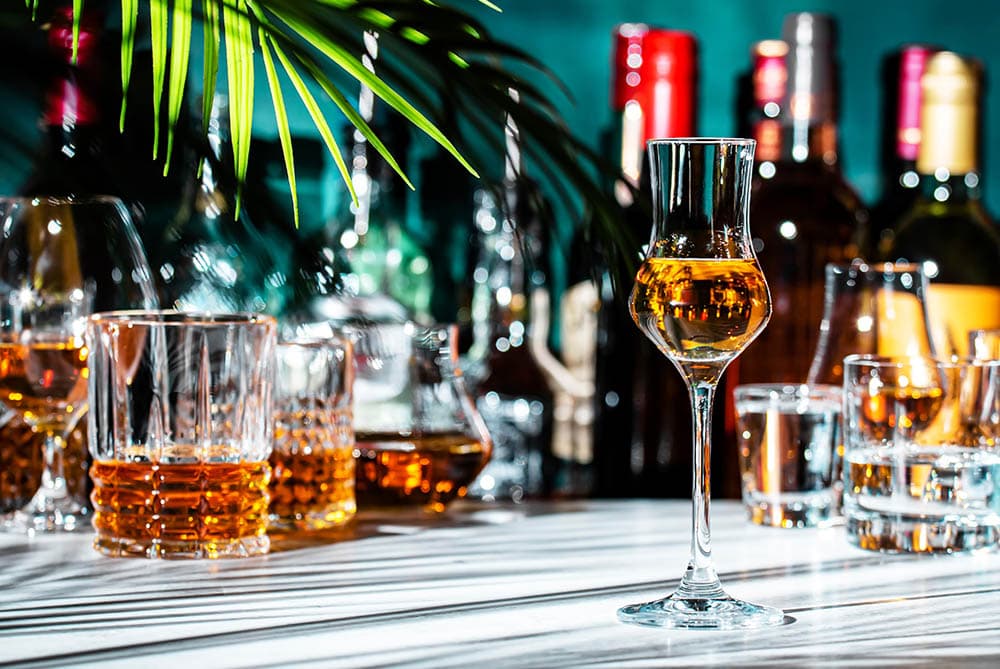
David Abzianidze: There is a proper way to taste brandy, and one important aspect of this is the shape of the glass. Of all the types available, the snifter is the best. It allows you to fully appreciate the aromas.
To fully appreciate the aromas, it is best to warm the brandy slightly. The optimal temperature is roughly that of your hand. In bars, brandy is sometimes warmed over a candle, but this often disperses the aromas. Chilling is also not recommended, especially with ice. The quality of this spirit is judged primarily by its aroma. Aromatic compounds are volatile and become locked at low temperatures, making them difficult to detect. Even gentle warming begins to release them. The older the brandy, the longer it should be warmed, particularly to reveal the piquant vanilla notes developed during oak ageing.
There are many types of wood in nature, but for ageing brandy, only oak has been chosen, thanks to the French. From the 17th century, brandy was sent from France to other European countries in casks made from various types of wood. Gradually, it was discovered that spirits aged better in certain types of casks. Through trial and error, it was determined that oak was the ideal choice. At the end of the 19th century, oak wood was studied in detail and it was found to contain all the usual components, including cellulose, hemicellulose, tannins, and colouring compounds, which are also present in other woods. But there was one component that set it apart, the phenolic compound lignin. This compound is either absent or present only in small amounts in other types of wood.
When young, highly active spirit enters the oak, it begins to extract all the components mentioned earlier. This is followed by an oxidation process. A cask is ideal for ageing because this process occurs naturally within it. It is the oxidation of lignin that produces the largest number of aromatic compounds. This phenolic compound is precisely what gives brandy its distinctive flavours and aromas.

Brandy is the only spirit made from two essential elements, grapes and oak wood. Remove either one, and it is impossible to speak of brandy.
Today, the sales of brandy and cognac no longer reach the levels they once did on international markets. This is a point often noted in France and Portugal. The main competitor for cognac and brandy is whisky. In modern bars, brandy is frequently served with ice or mixed with tonic, which, in my view, takes away its greatest quality, its aromas.
Giorgi Samanishvili: However, it should be noted that, in this way, bars are well aligned with the tastes and preferences of the younger generation, which is commercially advantageous.
David Abzianidze: The history of brandy in Georgia is closely linked to David Sarajishvili, a 20th-century public figure, philanthropist and innovator. At ‘Sarajishvili’ we continue to produce brandy successfully, offering brandies of various ages on both the local and international markets.
Levan Ujmajuridze: It should also be noted that David Sarajishvili’s predecessor, who is considered the founder of brandy production in Georgia, was Giorgi Bolkvadze. In 1865, at the company he established in the city of Kutaisi, he produced a brandy-style spirit and named it ‘Giorgi Bolkvadze’s Caucasian Natural Cognac.’ In addition to brandy, Bolkvadze also produced a variety of other spirits, including fruit distillates.

In Georgia, the development of brandy was made possible thanks to David Sarajishvili. He began producing this spirit in 1898. David was the only child of an educated and affluent family. His parents were prominent merchants and had the means to provide him with a quality education. Sarajishvili first studied in St Petersburg and then in Munich, Germany. While studying high-proof spirits, he discovered that among these types of drinks, cognac is unique in being made from grapes, primarily from three varieties, Folle Blanche, Colombard and Ugni Blanc. Georgia had more than 500 grape varieties, which prompted David Sarajishvili to travel to France and study cognac production in detail with Michel Camus, as he wanted to adapt this technology to Georgian grape varieties.
What makes these three French varieties interesting is that they are highly acidic and low in sugar. They are unsuitable for winemaking but ideal for cognac production, which requires precisely this high acidity. The higher the acidity of the wine, the more aromatic compounds, including aldehydes and esters, are transferred to the spirit. For brandy production, David Sarajishvili selected the best leading grape varieties from western Georgia, Tsitska and Tsolikouri, which are notable for their high acidity.
Levan Ujmajuridze: In this respect, Rkatsiteli was the dominant variety in eastern Georgia, particularly cultivated at the foot of the Caucasus Mountains on the left bank of the Alazani River, where there are alluvial soils. Varieties like this, from both western and eastern Georgia, became the foundation for well-known brandies such as Gremi, Vartsikhe and Eniseli. All three were created by Vakhtang Tsitsishvili.
History
In 1912, Vakhtang Tsitsishvili, with the support of David Sarajishvili, enrolled at the Faculty of Agricultural Technology at the Agricultural Institute in Dijon, France. After completing his studies, he returned to Georgia and began working at Sarajishvili’s cognac factory. From 1924, he served as a technologist, and from 1949 he held the positions of Deputy Director and Chief Technologist of the factory. Under his direct supervision, iconic Georgian brandies were created, including Eniseli, Gremi and Vartsikhe, all of which have won multiple gold and silver medals at international competitions and tastings.
Levan Ujmajuridze: The creation of these brandies was based directly on Georgian grape varieties. Suitable equivalents of the French varieties were identified, including Tsitska, Tsolikouri, Rkatsiteli, Chinuri, Goruli Mtsvane and Kakhuri Mtsvane. Later, another Imeretian variety, Dondghlabi, was added to the mix.
Here is a list of Georgian grape varieties mentioned in literary sources that were considered, and still are, potential bases for brandy production: Rkatsiteli, Tsolikouri, Tsitska, Dondghlabi, Andreuli Shavi, Andreuli Vardisperi, Buera, Gabasha, Chrogha Kakhuri, Dondghlabi Shavi, Dondghlabi Tsiteli, Vertkvichalis Tetri, Tavkveri Didmartsvala, Tavkveri Patalanteuli, Mgaloblishvili, Jachvadziseuli, Ghrubela Kartlis, Kakutura, Mtsvivani, Mirzaanuli, Zhghia Sagviano and Lakvazhi (an Abkhazian variety).
David Sarajishvili succeeded in creating a Georgian brandy empire using six grape varieties. To bring out the full potential of the grape varieties mentioned above, further research is needed in order to introduce greater diversity into brandy production. Some varieties have significant ageing potential and reveal their full organoleptic character only with time, which is especially important in the production of Georgian brandy.
Giorgi Samanishvili: When we talk about ageing, I must mention the traditional Chinese spirit, baijiu. Baijiu is made from a variety of grains, the most popular being sorghum, sorghum is similar to our local chada and ghomi grains, which is fermented using well-preserved traditional methods and then distilled. In China, it is very popular to age this spirit, baijiu, in porous clay (terracotta) vessels similar to our qvevri. This allows micro-oxygenation, which does not change the colour but refines the flavour and aroma. In my view, clear spirits, including ones like Georgian chacha, would benefit greatly from ageing in good clay vessels.
