
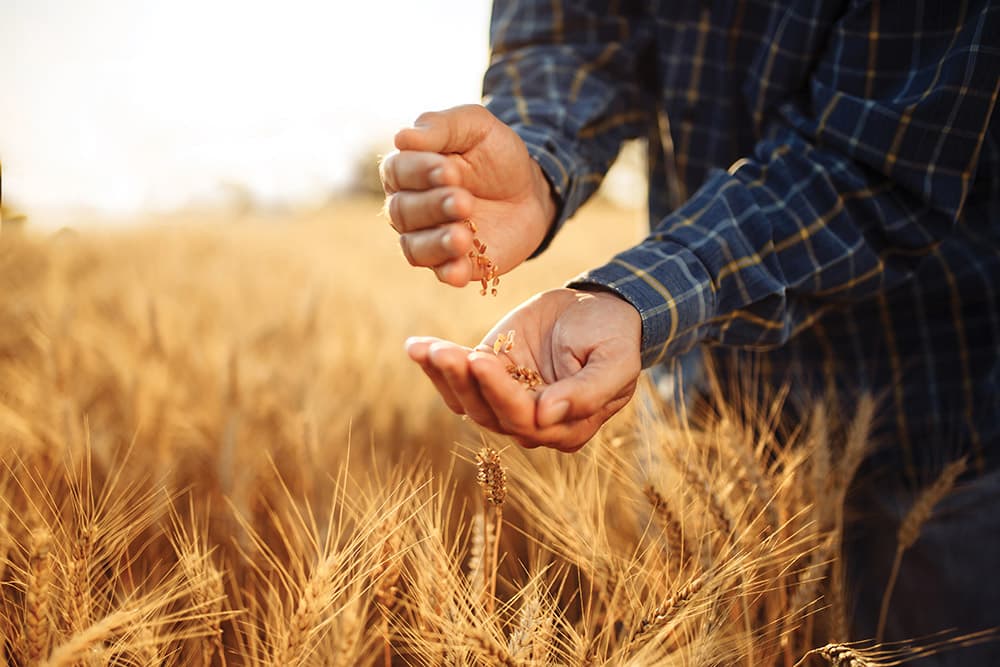
Georgian wheat, rooted in an uninterrupted agronomic tradition and centuries of experience, is one of the oldest in the world.
The five endemic species of Georgian wheat
Out of the 20 cultivated species in the wheat family, 14 have been recorded in present-day Georgia. Five of these are endemic, notable for their genetic resilience, exceptional agro-biological traits, and unique nutritional qualities.

Macha - Triticum macha Dekapr. & Men. (2n=42)

Historically grown in the mountainous Racha-Lechkhumi region, Macha is an ancient relict hexaploid wheat. It is considered the prototype of cultivated wheat varieties and a “living ancestor,” carrying traits of both wild and domesticated wheat.

Macha is the primary wheat species that gave rise to all cultivated hexaploid wheats. Fourteen distinct varieties of Macha have been described. Its grains are rich in B-group vitamins, and bread baked from this variety is considered among the highest quality by local communities. The flour has a pale colour, an exceptional flavour, and the loaves stay fresh for several days.
Chelta Zanduri - Triticum timopheevii (Zhuk.) Zhuk. (2n = 28)

Chelta Zanduri is an endemic wheat variety from Georgia. Its historical range included Racha-Lechkhumi, Samegrelo, and Imereti, growing at altitudes of 400–800 m above sea level. This variety is noted for its broad resistance to all major diseases and pests, which is why Georgia is considered the birthplace of immune wheat.

In wheat breeding, one of the greatest achievements associated with Zanduri is the discovery of cytoplasmic male sterility (CMS) genes, which enable the development of intensive wheat varieties and help address challenges in hybrid wheat production.
Chelta Zanduri grains are exceptionally rich in vitamin K. Traditionally, they were used to bake high-quality bread, with a fragrant aroma that could carry through 2–3 km during baking.
Hexaploid Zanduri - Triticum zhukovskyi Men. & Eritz. (2n = 42)
Hexaploid Zanduri is an endemic wheat variety from Georgia. It is difficult to thresh and morphologically resembles Chelta Zanduri, carrying the CMS gene. The variety shows strong resistance to fungal diseases, tolerates high humidity well, and exhibits chasmogamous flowering.

This high-quality wheat has a protein content of 23.6% and a lysine content of 2.9%. It is also prized for its excellent baking properties.
Kolkhuri Asli - Triticum georgicum (Dekapr. & Men.) Dekapr. (2n = 28)
Kolkhuri Asli is an endemic wheat variety from western Georgia, found in the Racha-Lechkhumi region. Historically, pure stands were rare, and it more commonly grew mixed with Macha wheat.

It is a monomorphic species, represented by only two known varieties. Kolkhuri Asli is highly adaptable, tolerates high humidity well, has strong tillering, and shows resistance to rust diseases.

This wheat is notable for its high content of fatty acids, including mono- and polyunsaturated fats, and is also rich in vitamin B9.
Endemic Georgian Wheat Varieties – Zanduri, Dika (T. carthlicum), and Hexaploid Zanduri (T. zhukovskyi) are characterised by a strong, broad resistance to fungal diseases and resilience to environmental conditions. These and other unique traits make them excellent sources of foundational genetic material and have earned them recognition in global wheat breeding.
In addition to the endemic species, over 154 varieties of wheat have been recorded in Georgia. These include both soft and hard wheats, representing some of the oldest local landrace populations with distinct ecological adaptations. Notable examples include: Kakhuri Dolis Puri, Akhaltsikhe Red Dolis Puri, Kartli Dolis Puri, Javakheti Dolis Puri, White Doli, Red Doli, Shinduri Doli, Shavphkha, Upkho Puri, Khulugo/Khulgo, Poshola, Khozo/Khuzala, Khotora, Gomborula, Niksavra, and others.

Soft wheat also includes husked forms, such as Ipkli and Dzvel Tesli, while hard wheat is represented by the Tavtukhi varieties, including Kartli Shavphkha, Red Tavtukhi, White Tavtukhi, and Shavphkha, among others.
Discovery, Conservation, and Distribution of Endemic and Local Georgian Wheat Varieties
For centuries, endemic and local Georgian wheat varieties were firmly rooted in the country’s traditional agriculture. Today, however, a range of factors has led to a significant decline in both the species and varietal diversity of Georgian wheat and the areas under cultivation.
In this context, the identification, conservation, production of high-quality seed, and distribution to farmers of these endemic and local varieties are essential. Combined with the development of sustainable agriculture, these efforts are crucial for safeguarding Georgia’s food security.
The Scientific‑Research Centre of Agriculture plays a leading role in this work. Its collections, both ex situ and on-farm, preserve more than 1,200 wheat samples. Alongside local varieties, these collections include over 600 genetic samples of foreign origin, imported from genebanks in Germany and the United States, as well as other wheat of Georgian origin with different statuses.
Five endemic Georgian wheat species and six local varieties have been included in the National Catalogue of Agricultural Crop Varieties approved for dissemination, making them available for wider cultivation.
In the context of international agreements, the Scientific‑Research Centre of Agriculture serves as Georgia’s national institution responsible for the country’s legislation on plant genetic resources. It is a member of the European Cooperative Programme for Plant Genetic Resources (ECPGR), whose governing committee will meet in Tbilisi in June 2026.

The Centre is also responsible for submitting data on the country’s genetic resources, including wheat, to the European Plant Genetic Resources Catalogue (EURISCO) and is integrated into the international network of genebanks.
Thanks to the efforts of the Scientific‑Research Centre of Agriculture, Georgia has established a seed certification system in line with European and international recommendations. Initial seed production of endemic and local wheat varieties is carried out according to their zones of origin, and certified wheat seeds are distributed for use on farmers’ fields.
In nearly every ethnographic region of Georgia, including the highlands of Tusheti, Pshav‑Khevsureti, Svaneti, and Racha‑Lechkhumi, farmers are cultivating endemic and local wheat varieties. There is growing enthusiasm for Georgian wheat seeds and the wide range of products made from them.
A National Plant Genetic Resources Seed Bank, vital for the country, is set to be established, with the project already finalised. Construction will begin in 2026 in the village of Jighaura, Mtskheta Municipality, enabling seed samples to be preserved using modern methods, including cryopreservation, in vitro techniques, and others, for both medium- and long-term conservation.
Recent nutritional studies carried out at the Austrian Agency for Health and Food Safety (AGES) on five endemic Georgian wheat species and seven local varieties assessed a broad range of 168 parameters. The results once again confirmed the uniqueness of Georgian endemic and local wheat varieties and highlighted their distinct potential for producing high-quality food products.
Local and International Recognition of Georgian Wheat
In 2025, samples of Georgian endemic wheat species and local varieties were placed in the Global Seed Vault in Svalbard (Spitsbergen), the world’s repository for long-term seed storage.
In December last year, at the 20th session of UNESCO’s Intergovernmental Committee for the Safeguarding of the Intangible Cultural Heritage, held in New Delhi, India, by decision adopted at the session, the nomination ‘Georgian Wheat Culture: Traditions and Rituals’ was inscribed on the Representative List of the Intangible Cultural Heritage of Humanity. National-level decisions preceded this international recognition. In September 2018, Georgian wheat culture was registered on the National List of Intangible Cultural Heritage, and in March 2019, by decision of the Prime Minister of Georgia, Georgian wheat was granted national importance status.

Georgian Wheat – Traditions and Heritage
The identity of the Georgian people is closely tied to wheat and bread, a tradition preserved continuously over millennia. It embraces all aspects of wheat cultivation and traditional bread-making. Sacred breads and grain-based ceremonial dishes, prepared from endemic and local wheat varieties, are an integral part of nearly every local ritual, from birth and marriage to death.
Wheat grains are harvested from the first furrow and stored separately. The best grains are reserved as sacred seed to be sown in spring during the week of the spring equinox, a time traditionally associated with renewal and new beginnings. Special types of sacred bread are baked for different rituals: in Tusheti - Kotori; in Svaneti - Lamziri; in Samtskhe-Javakheti - Kada and Nazuki; and in Imereti and Guria – Bediskveri, Ghvezeli, and others. Priests and nuns bake Sepiskveri, a communion bread.
Georgian wheat is an essential part of the Georgian table. The Georgian supra, a feast rooted in centuries of cultural tradition, brings together a wide range of traditional practices, with bread and wine holding a place of honour. In Georgian, the feast is called Puroba, a term derived from puri, meaning “bread.” In church, bread and wine also hold a sacred role, representing the body and blood of the Lord during communion.
Ritual and secular celebrations alike conclude with a shared table. Ritual feasts featuring Georgian wheat products and wine, whether for dining, weddings, funerals, or memorials, offer the perfect setting to express hospitality, creativity, and the sharing of joy or sorrow. Alongside wine, these tables feature a wide variety of breads, including yeast-free khmiadi puri, deda’s puri, shoti, lavashi, and others, which are enjoyed both as everyday staples and as part of ritual meals.
Through its vine and wheat cultures, Georgia has created a unique global diversity and heritage. This is a shared treasure that requires special care from society.