From Elisabethtal to the Present Day
The history of Asureti dates back to the early 19th century, specifically to 1818, when German settlers from Württemberg acquired a new homeland in Georgia, established a colony, and named it Elisabethtal. With them came European architecture, farming practices, and a remarkable sense of order. They built half-timbered houses, developed the village's infrastructure, and erected a beautiful Lutheran church. This harmonious coexistence came to an end in 1941, when the Soviet regime deported the German population to Central Asia. It was from that time that the village became known as Asureti.

Asuretuli Shala - History and PDO Wine
The discovery, cultivation, and continuation of winemaking from this unique Georgian grape variety is the legacy of the German settlers of Elisabethtal. According to legend, in the second half of the 19th century, a local German winemaker named Otto Schall discovered an unknown grape variety in the forests surrounding Asureti, began cultivating it, and produced wine from it. As a sign of respect, local people named the variety Shala’s grape (Schall-Traube), which later became known as Asuretuli Shala (syn. Asuretuli Shavi).


Today, Asuretuli Shala is a protected designation of origin (PDO) wine. It is distinguished by its intense ruby colour, aromas of forest berries, blackberry and ripe cherry, medium to high acidity and soft, velvety tannins. These qualities make it a wine that can be enjoyed both in its youth and after ageing.
Asureti is located at an altitude of approximately 550 to 650 metres above sea level. It has moderately cold winters and long, warm summers. During the summer months, temperatures can be quite high; however, a breeze descending from the valley brings cooler air at night. This variation in temperature helps maintain a balance between acidity and aromas in the grapes. Today, Asuretuli Shala occupies a total area of 5 hectares in the village.
Aleksandre Chichinadze, an Asureti-based winemaker and one of the founders of the Kvemo Kartli Winemakers' Union, believes that these areas need to be expanded: ‘Asuretuli Shala has great prospects in both the local and international markets, because modern wine lovers are looking for rare, indigenous varieties and wines with an interesting history.’
The Kvemo Kartli Winemakers' Union, which brings together small and medium-sized wineries from Tetritskaro (including Asureti), Bolnisi, and Marneuli municipalities, plays a crucial role in the development of viticulture in Asureti and the region as a whole. The Union is actively working on creating a regional brand, raising quality standards, and promoting local wines, including Asuretuli Shala.
The people of Asureti also have their own PDO wine festival, held in October at a historic location, the station built by the Germans (Bahnhof Station). This is a sign that the village, with its distinctive identity, is becoming established on the tourism and wine maps.

In this small village with a long history, each visit makes it increasingly clear how the past, architecture, nature, and gastronomy can come together to create a unified and unforgettable atmosphere. Today, Asuretuli Shala is no longer just a rare grape variety; it is a signature of the place, bringing together Georgian roots and German heritage in equal measure.
Where Flavours Meet
The Historic Station (Bahnhof Station) and Gastronomic Experiments

The synthesis of cultures is most clearly expressed through gastronomy. For an interesting culinary experiment in Asureti, we visited the historic Bahnhof Station. Although the word ‘Bahnhof ’ means railway station in German, the history of this building is slightly different and equally as fascinating. Built by the Germans at the beginning of the 20th century, this stone structure originally served as a vehicle and tractor station. Abandoned for decades and damaged by time, the building was restored several years ago. The Station has become a place that brings to life the character and history of an old European village. This historic setting demonstrates that in Asureti, history lives not only in books but also on the plate. At the same time, Asuretuli Shala is not merely a remarkable wine, but also a distinctive ingredient of the local cuisine.
Sausages Made Using German Techniques in an Asuretuli Shala Sauce

This dish is a direct reflection of the culinary heritage of the German settlers of Elisabethtal. Classic, juicy sausages served with a thick, spicy, and slightly sweet sauce made from Shala bring together German meat-making techniques and the character of the Georgian vine on one plate.
Local Cheese Aged in Asuretuli Shala

During ageing, the wine enriches the cheese with pleasant fruity aromas, particularly berry notes, while the cheese rind takes on a deep purple hue, and the inside remains light in colour. This kind of connection between wine and cheese is a popular trend in international gastronomy, similar to classics such as the Italian Formaggio Ubriaco and the Spanish Murcia al Vino.
Goulash with Asuretuli Shala

Slow-cooking meat in wine is part of the golden heritage of world cuisine. Examples include the French Boeuf Bourguignon and even the Italian Brasato al Barolo. Although traditional Hungarian goulash does not require wine, dry red wine is often used in its Western or German variations to deepen and enhance the flavour of the dish. At the Station, goulash is prepared using this very method and, of course, the wine of choice is Asuretuli Shala, a dry red wine.
Baked Apple with Walnuts and Honey in an Asuretuli Shala Sauce

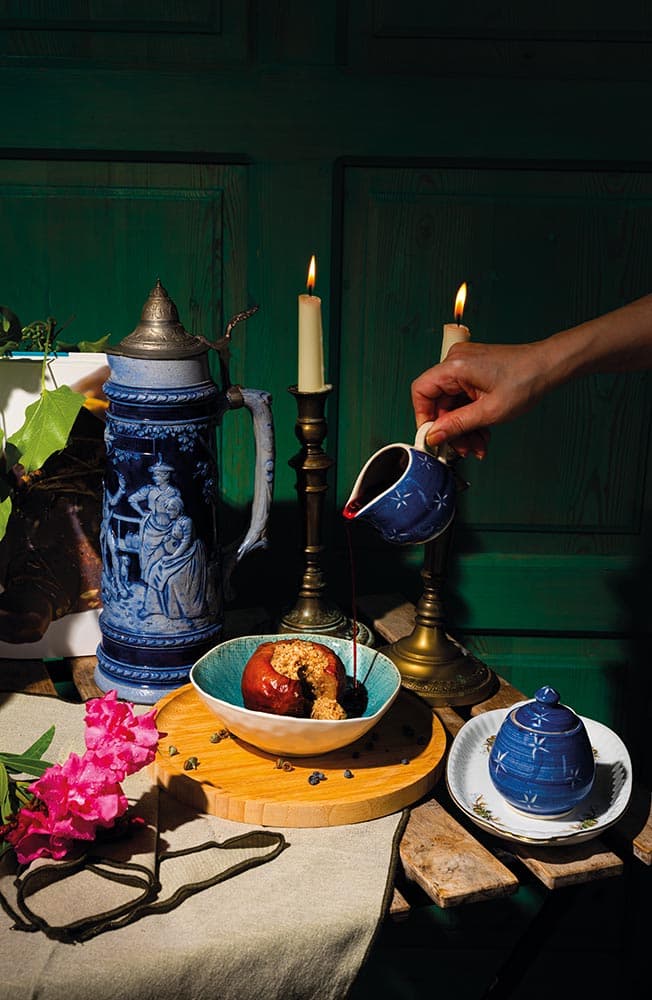
A dessert that evokes the feeling of autumn in Asureti. Oven-baked apples filled with walnuts and natural honey, served with a thick, aromatic syrup made from Asuretuli Shala. It is a dessert in which the sweetness and the wine’s gentle acidity create a perfect balance.