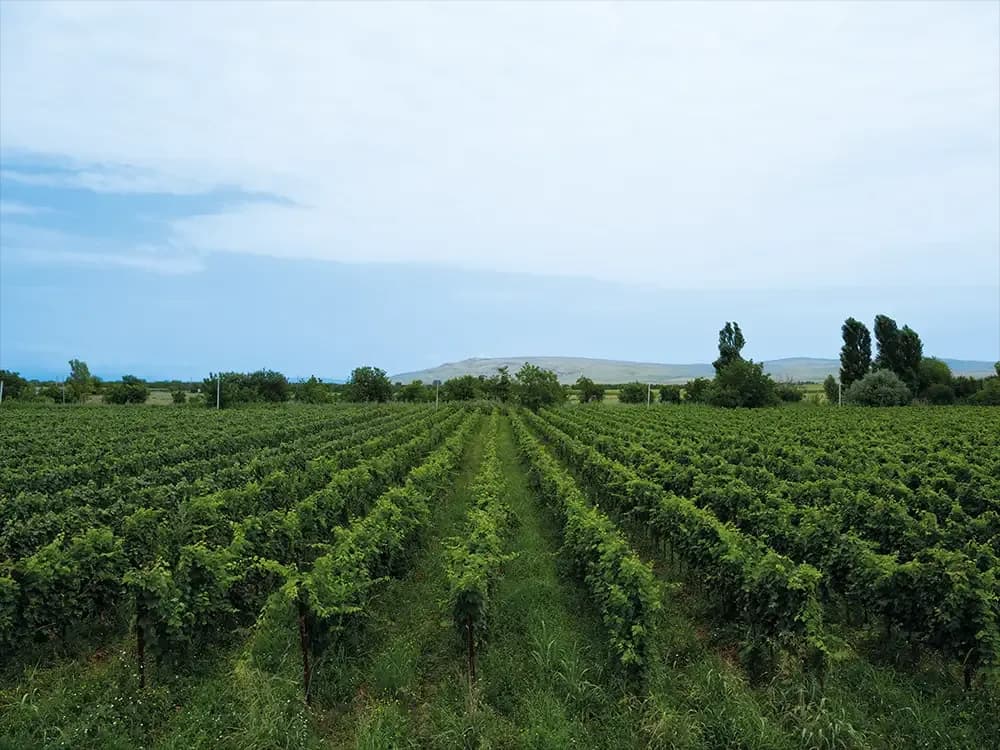
The terraced vineyards, old wine cellars, and centuries-old vines preserved in the valleys of the Mtkvari River and its tributaries, within the municipalities of Akhaltsikhe, Aspindza, and Adigeni, clearly demonstrate the important role this region has played in the history of Georgian winemaking. However, the reality is that, after centuries of disruption and historical upheavals, viticulture and winemaking in Meskheti are only now beginning to recover. You will not find extensive vineyards or a large community of producers here. The number of active wine cellars remains very limited. Gvinia is one of them, and it is where we are heading, while Memory House is where we will be staying.

Shalva Alelishvili | Winemaker: ‘Since 2023, Gvinia has fully shifted its focus to Kartli grape varieties. As a representative of Meskheti, I would like to shape the coming years’ portfolio around both Shida Kartli varieties and those of historical Zemo Kartli, namely Meskheti. For example, I see Meskhuri Mtsvane as best suited to blends and assemblages with Kartli varieties.’

The Architecture of Wine From Vardzia to Paravani
To fully understand Meskheti’s wine-growing potential, it is essential to examine the region’s history. Centuries ago, on the steep mountainous terrain, our ancestors planted vineyards on artificially created terraces known as oroko. These are vast earth-retaining walls built from dry stone without mortar, which support terraces along the mountain slopes. This system effectively protects the soil from erosion caused by rainfall and helps utilise solar energy more effectively. Such oroko terraces can still be found today at historic locations, including Saro, Gogasheni, Chachkari, Malakhevi, Khibazavra, Untsa, as well as Atskuri and Vardzia, where surviving old vines of endemic grape varieties can be found to this day.
Georgia is one of the oldest centres of terraced viticulture and farming traditions in general. Centuries ago, similar practices were widespread in Arabia, India, China, and beyond. Today, this approach to vineyard cultivation is widely practiced in countries such as France, Switzerland, and Italy.
The most striking example of this historical memory is the rock-hewn complex of Vardzia (12th–13th centuries), where archaeologists discovered 28 wine cellars and 235 qvevri, highlighting the scale of the local winemaking culture. Beyond Vardzia, Meskheti’s remarkable heritage unfolds before us: the fortresses of Rabati, Khertvisi, and Tmogvi, the megaliths of Saro, and religious centres such as the monasteries of Sapara, Zarzma, and Chule.
Even more mysterious is the Javakheti Plateau, where, in a basin between the Samsari and Javakheti ranges in the north-western part of the volcanic highlands, Lake Paravani lies at an altitude of 2,073 metres above sea level, its perfectly still surface resembling a mirror. The beauty of this lake is truly captivating both in summer and in winter, when it is covered with a thick layer of ice.
On its shore, the convent of Saint Nino in the village of Poka is today a centre of local gastronomy, where the nuns produce distinctive cheese and chocolate. All of this once again reveals why the land of Meskheti carries such a strong and enduring memory. To reach Aspindza, that is the route you must take.
Memory House - A Place for Memorable Experiences
After this impressive route, we arrive in Aspindza and stay at Memory House. This family-run hotel, created by Nino Alelishvili and her husband Gocha, has been designed with such care and aesthetic sensitivity that, the moment you step into the courtyard, you sense that this is a place where memorable moments are waiting to be created.


In summer, this place is immersed in greenery, and at dawn it comes alive with the uplifting sound of birdsong. In the evening, as the sun sets and the lights come on, the surroundings take on such a fairytale-like atmosphere that you might expect Alice from Lewis Carroll’s Alice’s Adventures in Wonderland, the Cheshire Cat with its broad smile, or even the Mad Hatter to appear and join you for tea on the guesthouse balcony. This place is filled with cosiness, warmth, and a very familiar kind of magic.


Memory House consists of three individual rooms. Every detail necessary for guests’ comfort has been thoughtfully considered. Regardless of the season in which you visit this historic region, this family-run guesthouse will welcome you and help you create lasting memories.
Across the street, you simply open the gate directly opposite and find yourself as a guest of the family winery Gvinia. This is one of the special advantages of staying at Memory House. Shalva Alelishvili, who leads this winery, is Nino’s brother.
A Philosophical Synergy: The Dialogue Between Tradition, Land, Vine, and Winemaker
Gvinia is located at an altitude of 1,125 metres above sea level. Shalva Alelishvili buried the first qvevri in this cellar in 2019. The 2021 Rkatsiteli, produced in these very qvevri, won a gold medal at Mundus Vini. The 2022 qvevri Rkatsiteli enjoyed the same success.


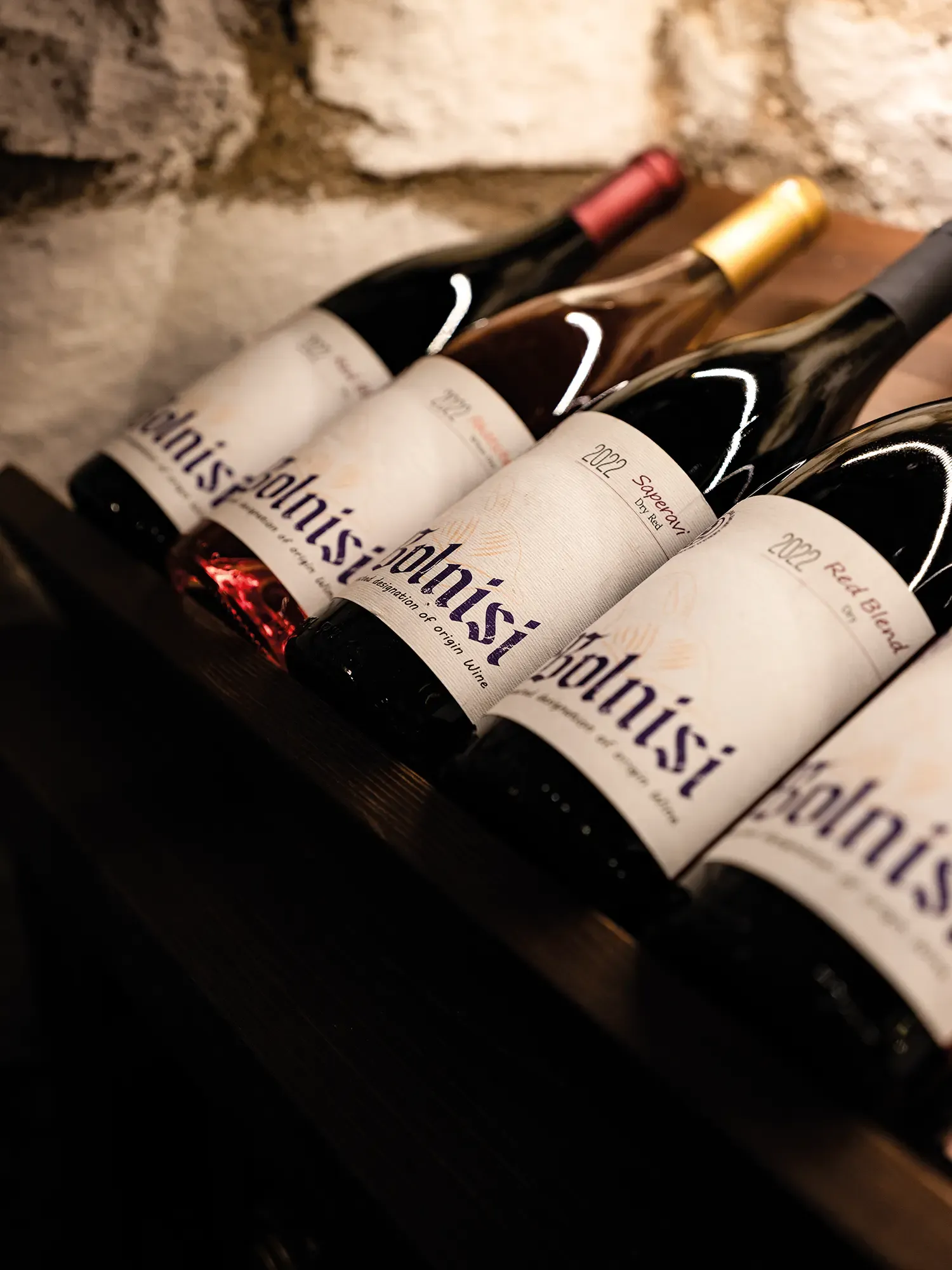
The winery’s visual identity is also distinctive: the label features the crown-shaped Meskhetian roof (mertskhlisbudura), a unique architectural form. This ancient architectural element, built in a pyramidal shape from wooden beams arranged at angles to one another, provided halls with light and warmth for centuries. Today, it symbolically and organically connects local cultural heritage with the art of winemaking. In the winery’s courtyard, an old local grape variety, Meskhuri Mtsvane, is planted on a small plot. Considering that vineyards are now rarely found in this region, each such example becomes even more significant.


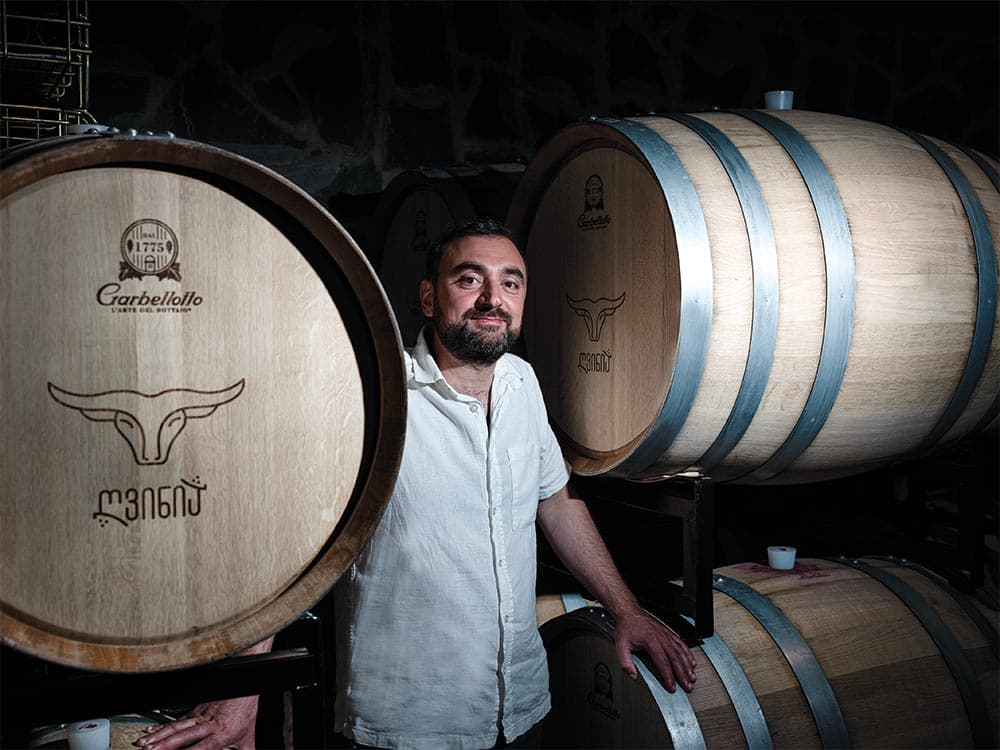
In the lower part of the winery, an enoteca has been created four metres below ground level. It is here, in Garbellotto barrels, that the wines undergo a significant stage of development. The 2024 Goruli Mtsvane and Kartlis Budeshurisebri Saperavi have already completed their barrel-ageing stage, been bottled, and are now undergoing bottle ageing before reaching local consumers and entering export markets. The wines made from the same varieties in 2025 are currently acquiring the noble tones of oak.


Shalva Alelishvili is a young winemaker, yet he already has a well-established and distinctive style that leaves a lasting impression. Dogmatic adherence to tradition is not the right approach in modern winemaking, something Shalva understands very well. His wines are therefore the result of a thoughtful balance between qvevri and oak barrels, combining depth, substance, modern expression, and elegance.
Gvinia’s portfolio reflects the winemaker’s mastery of different techniques and terroirs.
Chinuri, 2024. Wine made using the classic method.

Alcohol: 12.8%. Colour: Pale straw. A pure and elegant expression of the Okami terroir. Classic (European) vinification fully preserves the variety’s primary character. The bouquet is lively and refreshing, with dominant notes of lemon zest and ripe white fruit. The wine’s fresh acidity and moderate alcohol content create ideal harmony.
Kisi Reserve, 2022 Qvevri & Garbellotto barrel

Alcohol: 14.5%. Colour: Bright amber. Made in qvevri using the Kakhetian traditional method and then aged for five months in oak barrels, this wine is an excellent example of the harmonious synthesis of different techniques. It reveals delicate, elegant notes of ripe fruit, with particularly pronounced aromas of dried peach and pear. Full-bodied, structured, and perfectly balanced.
Rkatsiteli, 2022. Amber Wine. Mundus Vini Gold Medal Winner

Alcohol: 14.5%. Colour: Intense amber. This wine represents an international success for the winery, following in the footsteps of Gvinia’s 2021 Rkatsiteli, which achieved the same recognition. The bouquet is complex, filled with aromas of overripe white fruit and spices. Harmonious, with a long and rich finish.
Tavkveri Rosé, 2022. Classic method & oak barrel

Alcohol: 11.5%. Colour: Refined salmon pink. Impression: A lively, character-rich and elegant rosé with a rich berry profile of strawberry, raspberry and redcurrant. Notes of cornelian cherry appear on the palate. The wine is distinguished by its balanced acidity, while ageing in oak barrels adds pleasant structural finesse.