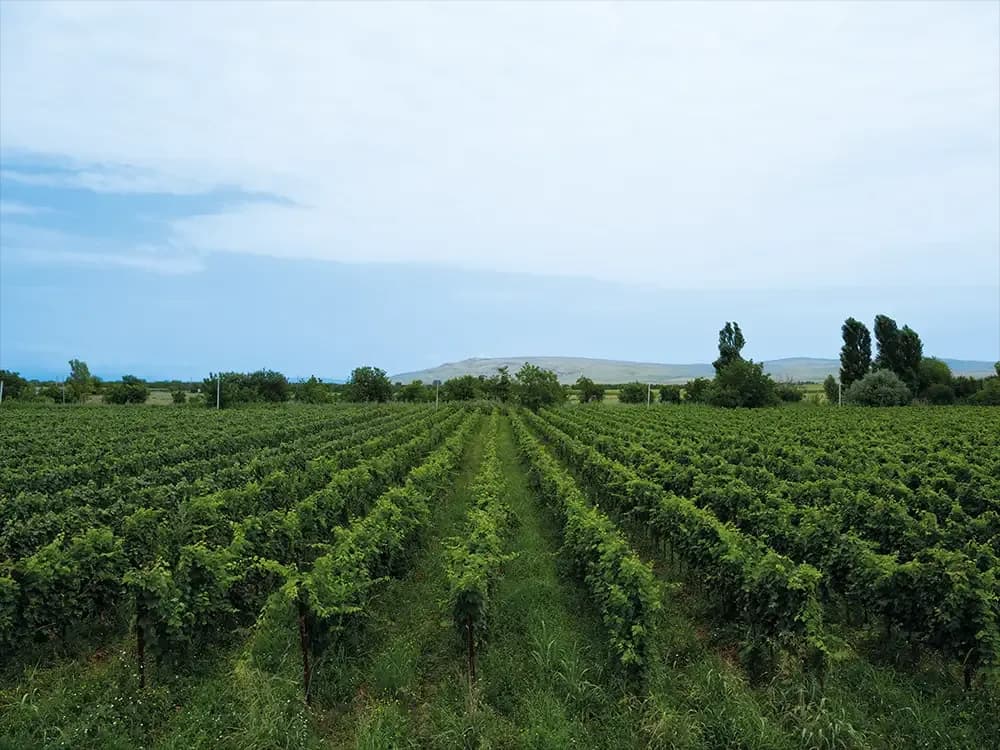
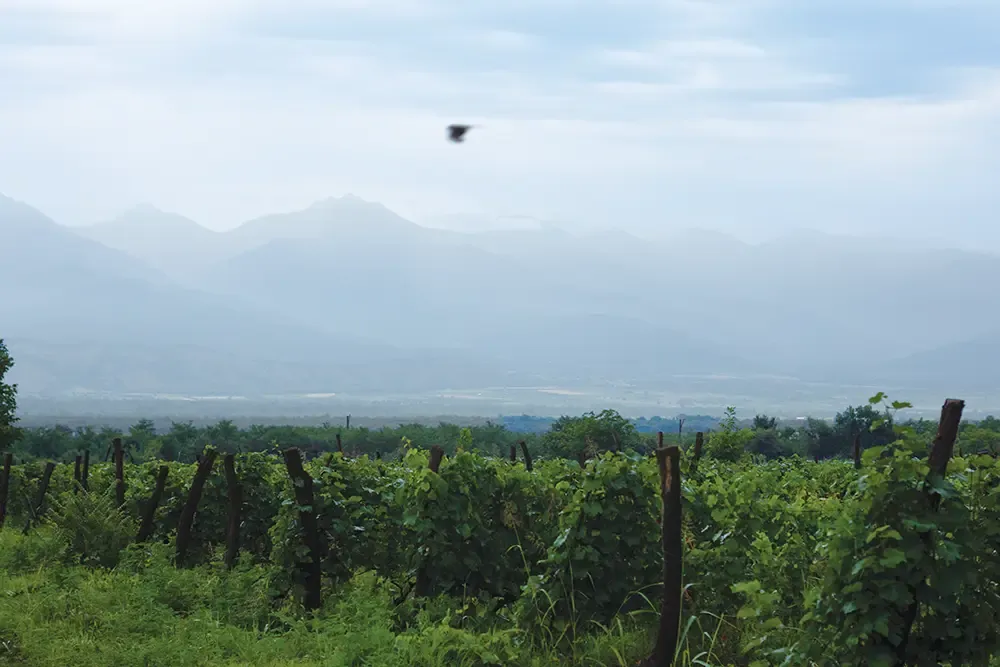
Vazisubani is one of the villages that form part of the Mukuzani micro-zone. The climate here is shaped by atmospheric processes that develop across subtropical and temperate latitudes, moving in from both the east and west. These are further influenced by cold air descending from the glacier-covered peaks of the Caucasus Mountains. The result is a moderately humid climate, with hot summers and relatively mild winters. The soils are predominantly clay, ranging from medium to heavy, with lighter types also found in some areas. The soil profile contains organic matter, limestone fragments and gravel. Calcium carbonate levels increase with depth, reaching up to 24% in some of the lower layers. Together with the site’s exposure, sunlight, and climatic conditions, these factors determine the high quality of the grapes and, in turn, the wine produced here. It is in this very micro-zone, in the village of Vazisubani, that Solomnishvili Family Winery’s XIII –Saperavi comes to life, a wine that truly reflects the history and identity of this region.
The vineyards supplying the grapes for the exquisite wines of Solomonishvili Winery are spread across several villages in the Kakheti region. One of these is Vazisubani — the winemaker’s birthplace. The sedimentary soils here, formed where water once stood long ago, are rich in clay and limestone. These qualities particularly benefit red wines, helping them retain minerality and colour pigments for longer. As a result, the wines are full-bodied and aromatic, says Giorgi Solomonishvili, founder and winemaker of Solomonishvili Winery. In addition to Vazisubani, the estate’s vineyards extend to Mukuzani, Shalauri, Telavi, Kindzmarauli and Vardisubani.

The winery produces between 40,000 and 45,000 bottles annually. Solomonishvili Winery’s range includes wines aged 5, 7, 10 years and beyond, featuring labels such as NINTEEN 84, #22 (Father), CHVEN (Us), EVO, and GELASI (Gela’s). Giorgi Solomonishvili exports these wines to markets including Japan, Lithuania, Latvia, France, Monaco, Germany, Italy, England, the Netherlands, Belgium, Denmark, the Czech Republic, the United States and Canada.
XIII
This is the wine from the 2014 vintage, sourced from a vineyard in Vazisubani comprising just 10 rows, each approximately 140 metres long. The production volume of wine made from the grapes of this vineyard is always limited, typically ranging between 1,500 and 2,200 bottles, depending on the vintage.
This is the wine that stands as a symbol of legacy, passed from Giorgi to his son Gela. Now 16 years old and born on the 13th, Gela is actively involved in the family winery’s work. The idea for the XIII label came from him, after a day of working in the vineyard, he gathered pruned shoots from the rows and arranged them in a way that formed the number thirteen (XIII) in Roman numerals. Those very shoots are featured on the wine’s label.

Solomonishvili Family Winery’s labels always feature minimalist visuals, while the wines themselves are known for their diverse, intriguing, and meaningful flavours and aromas. Each label carries a specific message encoded in numbers and symbols, inviting reflection. Only three colours dominate each design: black, white and red. This is also true for the XIII label.
Family wine means responsibility, not only for its quality but also for the future, says Giorgi. Who could be more trustworthy in the vineyard or with the wine than your own son? This wine represents responsibility for Gela, and for me, it is the hope that the legacy is in good hands. Although we were born and raised in Telavi, our roots come from the village of Vazisubani. That’s why this vineyard, where the XIII wine is made, holds a special emotional significance for me, as it’s connected to my father, who tragically passed away. I very much wanted to pass this connection on to my son as well.

XIII - The wine that embodies our dialogue with consumers about the traditions and values cherished Solomonishvili Family Winery. A dry red, it gracefully balances strength with serenity. Pronounced tannins are tempered by a moderate, refined structure. Notes of berry, black plum and soil unfold on the palate, while subtle chocolate undertones emerge as the wine develops in the glass.

Winemaking in Georgia spans centuries. It is in the Georgian DNA, passed down from generation to generation. Today, in many family-run wineries, the new generation actively continues the work begun by their ancestors. We cannot produce reserve wines every year, says Giorgi, because that depends on many factors, including the weather. Our experience is a vast knowledge passed down to our children — how to care for the vine, grow the grapes, and achieve a good harvest. Every vine has its own character. The relationship either forms between you and the vine and yields results, or it doesn’t. It is a bond that reveals its true reward only over time. Wine is the unity of time, patience, harmony with nature, and serenity- all captured in a bottle. That is exactly what XIII represents.

*In Georgian, the word for thirteen (XIII), ‘tsameti,’ contains tsa (sky) and meti (more), poetically evoking the idea of ‘sky and beyond’.